Sunday, January 3, 2010

flight to cebu

On September 20, I flew to Cebu. While waiting for my flight, there was announcement that there was going to hold mass near one of the gates. It turns out they were holding it right by the table at which I was sitting. So, when the priest started to set up behind me and the people started to gather, I had to move. Here is a picture taken after I'd vacated my spot.

This was the first time that I'd heard of or witnessed a mass at an airport. I knew about masses in malls in the Philippines. I find these religious celebrations at secular places both interesting and off-putting. I'm not sure why. I'd be interested in studying the phenomenon, though.

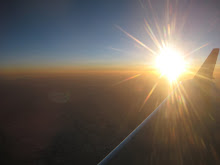
Once I was in the air, I took photos from the plane. The first picture was taken shortly after take off, I think. The rest are of various islands. Just don't ask me which ones!

lunch with an author

After discussing business with Mrs. Jose, she asked if I wanted to meet her husband. Who could say no to that? We went to his office, where I could see a typewriter and shelves of books. I wasn't exactly sure how one acts around a literary giant, but Mr. Jose is, I believe, used to the attention and he went ahead and did the talking.

After a few minutes, they said that we were going to lunch. We went to Kashmir, the Indian restaurant next door. (I believe it's the oldest Indian restaurant in the city, and the Joses highly recommended it.) Mr. Jose did all the ordering, but it turned out that he couldn't really eat any of it (he only ate some soup). I can't really remember all the names of the food we ate but, among others, we had samosas, bread, rice, and tandoori chicken. Here are some pictures:

I'm usually rather wary when it comes to Indian food--it's either really good or really bad. And I certainly would never think of having Indian food in the Philippines, but it was actually good.

While we were eating, Mr. Jose regaled us with stories of all sorts. He talked about growing up poor and coming to Manila and working as a cargador (porter) at the docks. He asked me to touch his hands to show that it is now super soft when it used to be really calloused from the hard labor he used to do. His story proves his point that "The poor are not poor because they are poor. They are poor because they are lazy." (That's the one quote that I remembered from that day.)

Here is a picture of Mr. Jose. Sorry for the fuzzy quality.

Mr. Jose also talked about old Manila, of which Ermita used to be a central part, and the changes they've seen. He also mentioned some of the writers who used to hang out at his shop. He talked politics, and so on.

Mr. Jose sure had a lot of stories to tell. He has opinions and is not afraid to voice them. I just felt privileged to hear them. It's always interesting to hear the stories of older people (Mr. Jose is in his 80s), but there is somehow a little awe mixed in knowing that this is someone who is famous and known for his storytelling.

solidaridad book shop

Solidaridad Book Shop is a small but clean and well-lit bookshop located on Padre Faura Street in the Ermita area of Manila. It was founded and still owned by award-winning Filipino author F. (Francisco) Sionil Jose and his wife, Teresita. It is located on the ground floor of an old wooden house, in which Mrs. Jose was born and grew up. (I believe they told me that is the only remaining wooden house on the block.)

Here is a picture of the outside of the shop. That is Mr. and Mrs. Jose. (This was taken after we had lunch. I will blog about this in a different entry).

A couple of my colleagues from other universities had mentioned Solidaridad to me before so I made sure to make an appointment so that I could learn about the shop and what it can do for the library. When I arrived on Saturday, September 19, I was ushered to the second floor (or maybe more of a mezannine area), where the offices are. There, I met Cesar, who I believe manages the store along with the Joses, and waited for Mrs. Jose. She then took me to the third floor (or I think that's actually the second floor), which is a wide open space with a big table. She told me that this was and continues to be a meeting place for Filipino intellectuals and writers.

Mrs. Jose and I discussed the kinds of materials that the book shop acquires and the kinds of arrangements they do with American libraries. In addition to Mr. Jose's own works, the shop acquires many materials from small publishers and self-published authors. From what I can tell, about half of the shop's inventory is on Filipino history and culture; the rest is on Southeast Asia and other parts of the world. (Mr. Jose later informed me that all materials actually pass through his hands and that he decides what can go in his shop.)

Here are some shots of the book shop. The section on the left has the Filipiniana materials. As you can see, I had to do some searching on titles here, too. And I had to sit, squat, and hunch over in turns. Again, it was a little hard on the body--I never even thought of this problem before I made this trip. Another lesson learned!

Having seen what other bookstores offer, I am impressed by Solidaridad. This is certainly a good place to acquire Filipino works, particularly those unlikely to be sold at chain stores. (Even if works are sold at chain stores, it is probably better to get them here anyway as they do not take out as much percentage from the authors.)

shabu-shabu

After the book fair, I went to eat shabu-shabu. I'd never tried it before. It's pretty good, but I don't really think it's my cup of tea.

searching & timing

On Friday, September 18, I was supposed to visit places, but instead I spent the entire day looking up titles from book lists that I had acquired from the Manila International Book Fair. Though I had anticipated having to do some bibliographic searching before I could acquire titles, I absolutely miscalculated the amount of time it would take. And this happened throughout the trip. So, the lesson is that, next time, I need to schedule more time for searching.

In the evening, I went back to the Book Fair. This time, I brough my laptop because I found out there was wifi there. And, there, I also searched titles. That was difficult to do, as there were no places to sit down. Instead, I was squatting and/or leaning against displays most of the time. My neck and back were not happy about that.

I went back to the ASEAN booth since it was empty the last time I came. I was rather annoying when I found out that many of the titles I had been interested in had already been purchased since the last time I was there. This tells me that these vendors only brought single copies of their titles, and that I need to be there first if I want them.

I did get to talk to the delegation from Brunei, and I found out that that was their last day there (the fair ran through that Sunday) because they wanted to be back home to celebrate the end of Ramadan. So, if I had come on a later day, I would also have missed the opportunity to purchase these titles. This just goes to show how unpredictable a book fair in Southeast Asia can be (I don't know what it's like in other regions)!

Tuesday, December 29, 2009

center for tarlaqueño studies

From Angeles City, we had to drive about another hour to get to Tarlac City, where Tarlac State University (TSU) and the Center for Tarlaqueño Studies are located. I took some pictures along the highway. The second picture is of Mount Arayat, legendary home of diwata (fairy) Maria Sinukuan.

As we were already running late to our second stop, needless to say, we were also late to this, our last place to visit. Luckily, when we were asking where we could find Lino Dizon, Director of the Center for Tarlaqueño Studies and with whom I had an appointment, he happened to be passing by.

He brought us to the Center, which is basically just a room. Here are some books, data, and artifacts on/from Tarlac.

Lino was genuinely quite happy to have me there. He wanted to introduce me to everybody. Here's a picture of me, Lino, and Glen Madriaga, University Vice President for Research, Extension, and Development at the Center. Lino also later took me to meet University President Priscilla Viuya.

Lino, whose current research interest is the Thomasites, or American teachers who came to the Philippines onboard the USS Thomas to establish a public school system, showed me this marker. It is dedicated to Frank Russell White, a Thomasite assigned to Tarlac and who founded the first high school (at the site where TSU is currently located) in the Philippines. Lino, whose latest book is on the Thomasite-established Baguio Teachers' Camp, is doing research on White.

Lino also introduced me to Rodrigo Sicat, Director of the University Testing Center and former director of the Center for Tarlaqueño Studies. Here is a picture of the three of us.

We had snack (in my case, late lunch) together, and Dr. Sicat entertained us with his stories and opinions. If we weren't so tired and if we didn't have a long drive home ahead of us, we might have just sat there and chatted the hours away.

I have to say that though this Center is the smallest (which does not mean it's not prolific in its publications), its directors, both current and former, are the most affable.

Monday, December 28, 2009

center for kapampangan studies

Because of the unplanned merienda break and the Barasoain tour, we were running behind schedule. We still had an hour drive to Angeles City, Pampanga, where we needed to find Holy Angel University and the Center for Kapampangan Studies.

It was past noon by the time we got to the University. A student gave us a tour of the very impressive Center. This is the beautiful sign outside the huge center, which includes a museum, a library, and an archives.

In the exhibits area, they have this gorgeous wooden timeline comparing the history of the world, the Philippines/Southeast Asia, and the Kapampangan people.

The room also has various artifacts, such as weapons, pottery, etc., as well as the death masks of two of its famous sons: slain former Senator Benigno Aquino, Jr. and actor/presidential candidate Fernando Poe, Jr.

Upstairs is a pictorial display.

In the lobby area are several notable displays. There are three interactive stations on Kapampangan songs and music, ancient script, and map.

Here are some samples of baybayin, the ancient Filipino script, from various sources/regions.

Nearby is a retablo featuring the patron saints of the various towns in the province of Pampanga.

Also in the lobby are samples of the parols, or Christmas lanterns, for which Pampanga is known. This parol is made of capiz (shell), and it has lightbulbs inside.

This is a regular-size, simpler version of the giant lanterns featured in the annual Giant Lantern Festival.

A drum actually contains the lighting design. When hand-cranked, the appropriate design segments hits the metal plate which then triggers the corresponding lights (something like that, anyway.) Here is what it looks like when it is cranked.

Apparently, the giant ones operate under the same concept. Several barrels control the lighting for each lantern. Here's a video.

To the left of the lobby is the reading room/library. The ground level has study tables; on the mezzanine (pictured) are some monographs.

After the tour of the first level, we were taken to the film room on the second level, where we saw an introductory film about the Kapampangan people and culture. You can watch the video in its entirety here.

Also on the second floor (or maybe it was on the third floor) is the display of the Center's rarer manuscripts and other archival materials.

Here is the preservation area. I can't remember if this is on the second or third floor.

The Center for Kapampangan Studies is really beautiful and very impressive. It looks like it could be in a developed country, instead of a developing one. I wish all the other local studies centers could have the funding so they can have a center like this one!